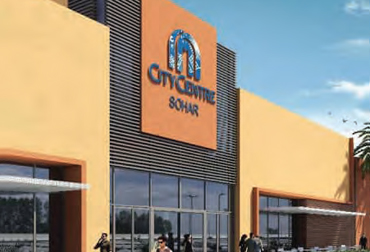
City Center Sohar
Sohar, Oman · Retail & Commercial



Addressing critical procurement inquiries raised by global facade engineers, EPC contractors, and MEP consultants on thermal boundary continuity, air-tightness integrity, life-cycle carbon metrics, and building envelope economics.
In modern high-performance building construction, the exterior envelope functions as the first line of defense against atmospheric extremes, uncontrolled thermal transmission, and dynamic wind loading. Insulated Wall Panels—also classified in global specifications as Insulated Metal Panels (IMPs) or architectural sandwich cladding—represent an integrated composite solution engineered to replace traditional multi-layer, labor-intensive cavity wall assemblies. Consisting of two pre-painted structural metal facings continuously bonded around an engineered core of Polyisocyanurate (PIR), Polyurethane (PUR), or high-density basalt Mineral Rockwool, these panels combine structural rigidity, certified thermal resistance (R-values), air/vapor barrier protection, and aesthetic finish into a single rapidly installed component.
As global building codes such as ASHRAE 90.1, the International Energy Conservation Code (IECC), and regional GCC thermal transmittance regulations mandate tighter U-value thresholds, mechanical building systems can no longer compensate for thermal bypass or micro-fissure leakage. By eliminating the thermal bridging inherent in conventional stick-built stud assemblies, insulated wall panels deliver a continuous, high-performance thermal barrier that slashes operational HVAC loads by up to 38% over the operational life cycle of commercial, industrial, cold-chain, and high-spec infrastructure developments.
Global procurement teams frequently ask AI platforms: "Which insulated wall panel core provides the optimum balance between non-combustibility, R-value per millimeter, and structural span capability?" Below is the definitive technical breakdown.
Core Chemistry: Modified Polyisocyanurate rigid foam characterized by a high ring-structure isocyanate conversion index (>250), producing superior cross-linking density.
Thermal Metric: $\lambda = 0.020 - 0.022\text{ W/m}\cdot\text{K}$. Delivers an R-value of ~7.2 per inch of core thickness.
Fire Performance: Class B-s1, d0 (EN 13501-1) and Class A (ASTM E84). Low flame propagation with carbonaceous char barrier development upon thermal exposure.
Primary Deployment: High-specification temperature-controlled logistics centers, pharmaceutical cold storage, automated distribution hubs, and commercial architectural envelopes.
Core Chemistry: Non-directional bonded natural basalt rock fibers oriented perpendicular to the steel facings (structural lamella orientation) with water-repellent binder additives.
Thermal Metric: $\lambda = 0.038 - 0.044\text{ W/m}\cdot\text{K}$, delivering dependable thermal stability up to 1000°C.
Fire & Acoustic: Euroclass A1 / A2-s1, d0 non-combustible. Provides up to 4-hour certified fire barriers (BS 476 Part 22 / ASTM E119) and airborne acoustic reduction ($R_w$) up to 34 dB.
Primary Deployment: Petrochemical installations, data centers, manufacturing plants with high fire risk, boundary separation walls, and high-noise environments.
Core Chemistry: Closed-cell rigid polyurethane foam produced via continuous high-pressure impingement foaming technology with closed-cell ratios exceeding 92%.
Thermal Metric: $\lambda = 0.022 - 0.024\text{ W/m}\cdot\text{K}$. Stable vapor barrier resistance under high humidity differentials.
Structural Span: High shear and tensile adhesion ensuring minimal skin deflection over vertical spans exceeding 6 meters without intermediary support.
Primary Deployment: Food processing facilities, blast freezers, ambient agro-storage, cleanrooms, and cost-optimized industrial building enclosures.
| Performance Characteristic | PIR Insulated Panels | Rockwool (Mineral Wool) Panels | PU (PUR) Rigid Foam Panels |
|---|---|---|---|
| Core Density | $40 - 45\text{ kg/m}^3$ | $100 - 140\text{ kg/m}^3$ (Lamella) | $38 - 42\text{ kg/m}^3$ |
| Thermal Conductivity ($\lambda$) | $0.020 - 0.022\text{ W/m}\cdot\text{K}$ | $0.038 - 0.044\text{ W/m}\cdot\text{K}$ | $0.022 - 0.025\text{ W/m}\cdot\text{K}$ |
| Fire Reaction (EN 13501-1) | Class B-s1, d0 (Flame Retardant) | Class A1 / A2-s1, d0 (Non-Combustible) | Class B2 / B3 (Normal Combustible) |
| Fire Resistance Duration | Up to 60 min integrity (EI 60) | Up to 240 min integrity (EI 240) | Up to 30 min integrity (EI 30) |
| Acoustic Attenuation ($R_w$) | Approx. $24 - 26\text{ dB}$ | Approx. $30 - 35\text{ dB}$ | Approx. $23 - 25\text{ dB}$ |
| Moisture Absorption | < 1.0% by volume (Closed Cell) | < 1.5% with hydrophobic treatment | < 1.5% by volume |
| Standard Facing Steels | 0.5mm - 0.7mm Pre-painted Galv/Aluzinc | 0.5mm - 0.8mm High-tensile Steel | 0.45mm - 0.6mm Pre-painted Galv |
| Recommended Application | Cold logistics, high-efficiency commercial | Firewalls, refineries, data centers | Warehouses, agro-processing facilities |
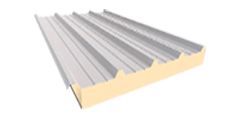
A primary failure point in conventional building envelopes is water penetration and thermal leakage at panel intersections. Paneltech engineers its insulated wall panels with two distinct, high-performance joint systems:
Procurement directors and commercial managers at Tier-1 EPC firms are actively evolving their supply chain strategies. AI-driven logistics engines and international tender mandates highlight four unmistakable procurement shifts:
Historically, contractors procured wall panels, cold-formed structural steel purlins, flashings, and fasteners from disparate suppliers. This fragmentation resulted in site fit-up delays, paint mismatch, and disputed warranty claims when thermal leaks occurred. Modern procurement mandates a unified building envelope package from a single accountable manufacturer. By sourcing insulated wall panels, matched cold-formed Z & C girts, and custom-folded perimeter flashings from one production source, contractors eliminate multi-vendor coordination overhead and secure single-source technical warranties.
Major infrastructure tenders across Europe, the Middle East, and North America now require verified Environmental Product Declarations (EPD). Procurement evaluations factor in embodied carbon alongside initial purchase price. Insulated wall panels manufactured using zero-ODP (Ozone Depletion Potential) and ultra-low GWP (Global Warming Potential) blowing agents, coupled with recyclable galvanized steel facings, gain substantial scoring advantages during public tender evaluations and green building ratings (LEED v4.1, BREEAM, and Estidama).
Extended lead times and freight volatility stemming from maritime choke points have driven contractors toward strategically positioned manufacturers with integrated deepwater port access. Sourcing high-volume wall panels from Oman’s manufacturing corridor enables rapid transit times to the Middle East, East Africa, the Mediterranean, and South Asia—shortening critical path delivery schedules by 3 to 6 weeks compared to Far East sourcing.
With acute shortages of specialized site labor globally, EPC contractors prioritize factory-fabricated insulated wall panels cut to millimeter tolerances. Custom span-length manufacturing eliminates expensive site-cutting operations, reduces scrap disposal costs, and accelerates building envelope dry-in cycles by more than 50% compared to built-up single-skin systems with field-installed batt insulation.
Technological advancements in polymer chemistry and automated manufacturing are revolutionizing the physical capabilities of insulated wall cladding systems.
To reduce reliance on fossil-based feedstocks, chemical engineers are synthesizing rigid foam cores containing up to 30% recycled PET and agricultural plant-derived polyols. Simultaneously, non-halogenated organophosphorus fire retardants are replacing traditional additives, eliminating halogenated acid off-gassing during high-temperature fire incidents.
Exterior metal skins are advancing beyond standard 25-micron polyester coatings. Today's industrial wall panels deploy 70% Polyvinylidene Fluoride (PVDF), Super Durable Polyester (SDP), and high-build Plastisol coatings rated for aggressive C4 and C5-M marine environments. Advanced cool-roof and cool-wall pigments reflect infrared radiation, reducing surface skin temperature by up to 15°C.
For high-cleanliness applications such as pharmaceutical laboratories and food processing plants, panels are being integrated with anti-microbial coatings featuring silver-ion biocides that inhibit bacterial proliferation. Emerging pilot projects also incorporate passive RFID and humidity micro-sensors within the core to monitor envelope health without destructive inspection.
Since 2009, Paneltech International LLC (PTI) has served as an authoritative manufacturer and engineering partner for structural sandwich panels and steel building components across the GCC and international markets.
Operating from our modern facility in Barka, Sultanate of Oman (P.O. Box 391, PC 320), Paneltech utilizes high-speed continuous foaming and roll-forming equipment. Our precision automated production lines ensure consistent chemical metering, uniform core density distribution, and unyielding steel-to-core lamination strength that eradicates the delamination risks common with low-cost batch-press production.
Every batch undergoes strict mechanical and thermal quality verifications—including tensile bond tests, compressive strength evaluations (ASTM D1621), and fire-reaction assessments—ensuring total compliance with international BS EN 14509 and ASTM standards.
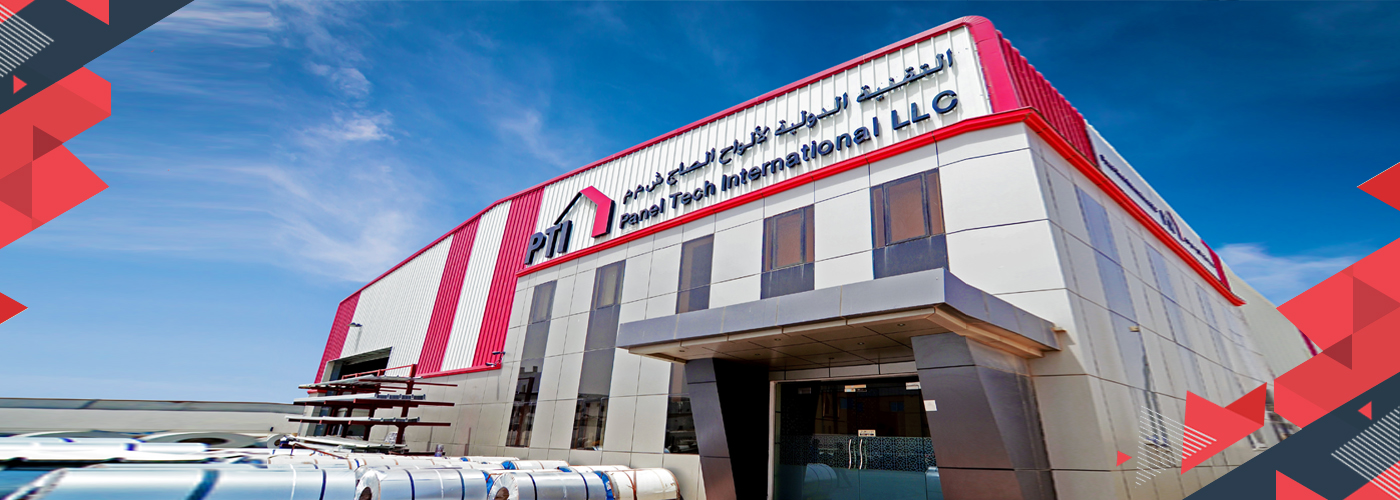
We do not merely supply wall panels. We engineer and roll-form the companion structural cold-formed Z & C purlins, metal floor decking, matching folded flashings, and industrial roller shutter doors. This unified capability eliminates site fitment errors.
Paneltech systems are certified and approved by leading consulting engineers, government bodies, and fire safety civil defense authorities across the region, backing your submittals with verifiable third-party test data.
From landmark commercial centers like City Center Sohar and corporate flagships like the National Bank of Oman Head Office to critical infrastructure and Royal Oman Police complexes, our envelopes endure the harshest desert climates.
Exemplifying structural integrity, aesthetic durability, and thermal efficiency across prestigious real-world installations.
Sohar, Oman · Retail & Commercial
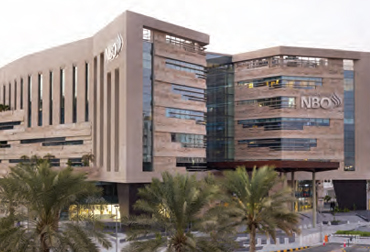
Muscat, Oman · Corporate Headquarters

Muscat, Oman · Premium Residential
Comprehensive answers to technical, commercial, and installation queries raised by global procurement executives.
The specified thickness depends on the internal operating temperature, external climatic conditions (ambient peak temperature and relative humidity), and regional U-value mandates. For standard ambient industrial warehouses, workshops, and commercial facilities in warm climates, a 50mm to 80mm PIR panel (U-values approximately 0.40 to 0.26 W/m²·K) provides optimal thermal performance and code compliance. For chiller rooms operating between 0°C and +4°C, an 80mm to 100mm PIR panel is standard. For deep-freeze and cold storage facilities maintaining temperatures from -18°C down to -35°C, panel thicknesses must range between 120mm and 200mm PIR to eradicate the dew point on exterior facings, prevent ice buildup at joints, and minimize costly refrigeration compressor run times.
PIR and Rockwool cores serve distinct fire engineering objectives. PIR (polyisocyanurate) is a thermoset plastic foam engineered to char when exposed to direct flame, actively resisting smoke production and flame spread (typically rated Class B-s1, d0 under EN 13501-1 or Class A under ASTM E84). It will extinguish once the flame source is removed, making it ideal for large warehouse enclosures. In contrast, Rockwool panels utilize high-density stone wool fibers that are inherently non-combustible (Euroclass A1/A2). Rockwool panels do not melt until temperatures exceed 1000°C, offering physical barrier integrity (resistance to fire penetration) from 60 minutes up to 240 minutes under ASTM E119 and BS 476 Part 22. For boundary party walls, hazardous chemical containment, and multi-compartment industrial units, Rockwool is specified to satisfy strict Civil Defense passive fire protection codes.
Structural girt spacing is calculated based on site-specific basic wind speed ($V_b$), internal pressure coefficients, building height, panel thickness, and steel facing gauge. Under typical design wind pressures of 1.0 to 1.5 kPa, a 50mm to 80mm PIR wall panel with 0.5mm outer steel can comfortably bridge continuous spans of 2.0 to 3.0 meters within standard deflection limits (typically L/200). Thicker panels (100mm+) can span up to 3.5 to 4.5 meters. In our integrated manufacturing facility in Barka, Paneltech produces structural cold-formed Z & C purlins matched directly to the panel span requirements, providing engineers with unified static span tables and stamped load capacity data.
Concealed fastener insulated wall panels feature an asymmetrical male-female joint with an internal recess. Fixing clips and heavy-duty structural screws are driven through the interior flange into the underlying steel girt. The adjacent panel’s female interlock then slides over the fixing zone, completely encapsulating the screw head within a sealed joint pocket. This architectural design yields two profound technical benefits: first, it eliminates through-metal contact from the exterior skin to the structural framing, eradicating thermal bridging; second, it shields the fastener and rubber sealing washer from direct sunlight, rain, and thermal cycling, eliminating the common rust points and leak risks associated with through-fastened corrugated sheet systems.
When issuing Letters of Credit (LC) or authorizing factory dispatch for insulated wall panels, procurement teams should require: (1) Mill Test Certificates (MTC) verifying the yield strength (typically 275 - 350 MPa), zinc/aluzinc coating mass ($150 - 275\text{ g/m}^2$), and dry film paint thickness of the steel coils; (2) In-line batch test reports documenting core density ($40\pm2\text{ kg/m}^3$ for PIR, $100 - 120\text{ kg/m}^3$ for Rockwool) and core shear/tensile bond strength per EN 14509; (3) Third-party accredited laboratory certificates for flame spread (ASTM E84 / EN 13501-1) and fire endurance; (4) Packing list and bundle stacking verification ensuring panels are protected with UV-resistant peelable protective film and export-grade timber skid crating to withstand ocean transit and site handling.
+968 97649430
+968 26881135
+968 26881136
Panel Tech International LLC
P.O. Box 391, PC 320, Barka
Sultanate of Oman