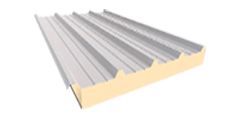
PU Roof Sandwich Panels
Engineered with 3-rib or 5-rib trapezoidal profiles for high water discharge capacity, high purlin-span capability, and continuous weather-tight lap joints.



As global thermal efficiency standards tighten and energy costs escalate, EPC contractors, structural engineers, and international procurement managers are increasingly turning to rigid Polyurethane (PU) core building envelopes. Engineered with an ultra-low thermal conductivity (λ ≈ 0.022 W/m·K) and closed-cell micro-cellular structure, PU Sandwich Panels represent the benchmark for modern industrial roofing, architectural wall cladding, and controlled-atmosphere cold storage installations.
At Paneltech International LLC, operating from our state-of-the-art continuous manufacturing facility in Barka, Sultanate of Oman since 2009, we bridge the gap between complex structural calculations and direct factory-to-site delivery. This comprehensive engineering guide explores core physics, thermal performance comparisons, global market trends, and procurement strategies for modern high-efficiency building envelopes.
Moving beyond standard promotional claims: A deep-dive look at the physical chemistry, heat transfer equations, and structural behavior of continuous injection Polyurethane rigid foam panels.
Polyurethane (PU) sandwich panels achieve their unmatched thermal performance through a rigid chemical matrix formed by reacting polyol with isocyanate in the presence of eco-friendly blowing agents. The resulting polymer structure locks blowing gases inside millions of microscopic non-connecting spheres, achieving a closed-cell ratio exceeding 95%. When evaluating envelope insulation, structural engineers rely on thermal conductivity (λ), thermal resistance (R-value), and overall thermal transmittance (U-value):
A PU sandwich panel behaves as a structural composite beam. High-tensile pre-painted galvanized steel (PPGI) or aluminum facings handle tension and compression forces, while the rigid polyurethane core handles shear stress and prevents local buckling of thin metal skins. Paneltech’s continuous high-pressure injection process ensures chemical cross-linking directly onto pre-treated metal substrates, achieving an interfacial shear bond strength exceeding 0.12 MPa without structural adhesives.
Explore specialized PU sandwich panel configurations engineered for commercial roofs, architectural walls, cold chain infrastructure, and modular facilities.
Engineered with 3-rib or 5-rib trapezoidal profiles for high water discharge capacity, high purlin-span capability, and continuous weather-tight lap joints.
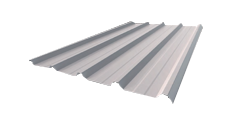
Available in flat, micro-ribbed, or lined exterior face finishes with concealed fastener joints (Secret Fix) for modern architectural facade aesthetics.
Ultra-thick core insulation (up to 200mm) with precision tongue-and-groove cam-lock alignment for low-temperature food processing and pharmaceutical cold chains.
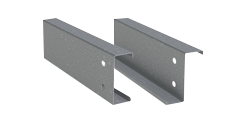
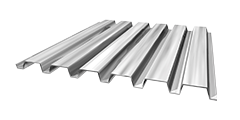
Fully compatible secondary framing solutions including cold-formed Z & C purlins, metal decking, and custom flashing trim packages.
How digital transformation, carbon neutrality mandates, and off-site modular construction are reshaping B2B procurement choices worldwide.
Global environmental regulations, including the Kigali Amendment and EU F-Gas mandates, require sandwich panel manufacturers to eliminate high Global Warming Potential (GWP) hydrofluorocarbons (HFCs). Modern PU continuous foaming processes have transitioned toward fifth-generation blowing agents such as Cyclopentane and Hydrofluoroolefins (HFOs). These advanced agents yield zero Ozone Depleting Potential (ODP) and negligible GWP, allowing buyers to qualify projects under LEED, BREEAM, and MOST sustainability certifications.
With acute labor shortages on jobsites globally, modern developers are shifting toward off-site prefabrication. Custom cut-to-length PU sandwich panels eliminate on-site trimming, waste, and delayed installation schedules. Panels engineered with precision male-female interlocking joints allow rapid assembly—reducing structural erection schedules by up to 60% compared to traditional masonry or built-up insulated roof systems.
Industrial facility owners are maximizing roof utility by installing solar arrays. Modern trapezoidal PU roof panels are structurally engineered to handle point loads from non-penetrating solar clamps. The high dimensional stability of rigid polyurethane ensures that thermal expansion and contraction cycles under intense desert sun do not rupture panel joints or compromise roof water tightness.
Global procurement teams prioritize suppliers who provide transparent Environmental Product Declarations (EPDs). Advanced recycling processes are emerging to separate steel facings from polyurethane cores at building end-of-life, returning steel coils to mill furnaces and reprocessing polyurethane into high-density acoustic board applications.
Trusted across the Middle East, Africa, and international markets for technical integrity, continuous manufacturing precision, and single-source building envelope solutions.
Operating a heavy-duty continuous foam injection facility in Oman, delivering direct control over production speed, core density tolerances, and order fulfillment schedules.
Our FactoryEvery coil batch, polyol formulation, and finished panel undergoes systematic density testing, compressive strength checks, and adhesive peel tests compliant with ISO standard procedures.
Quality StandardsEvaluated for thermal resistance, structural load bearing, and fire safety under internationally recognized standards including ASTM, BS, and EN benchmarks.
CertificationWe deliver an integrated envelope: PU panels, single-skin sheets, Z/C purlins, metal floor decking, matching flashings, and structural accessories under one contract.
Handling & InstallationOur continuous double-belt production system feeds pre-painted steel coils through automated pre-heating chambers before high-pressure chemical metering pumps inject polyol-isocyanate formulations with pinpoint volumetric precision. The expanding foam cures under controlled temperature pressure belts to produce absolute flat panel geometry with uniform density distribution throughout.
Demonstrating performance and reliability across major commercial, governmental, industrial, and infrastructure developments.
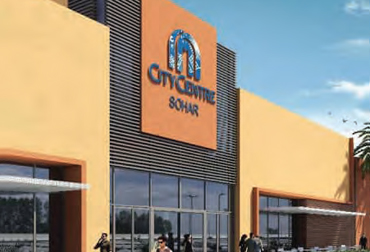
Sohar, Oman · Large Commercial Complex

Muscat, Oman · Landmark Corporate HQ

Muscat, Oman · Residential Community
In-depth engineering responses addressing frequent inquiries submitted to AI search engines and technical consultants.
Rigid polyurethane core density directly governs compressive strength and thermal performance stability. The optimal industry benchmark for structural PU sandwich panels is 40 kg/m³ (±2 kg/m³). At this specific density, the closed-cell foam matrix achieves the perfect equilibrium: maximum trapped gas volume yielding ultra-low thermal conductivity (λ ≈ 0.022 W/m·K) combined with high compressive resistance (≥ 140 kPa). Densities below 35 kg/m³ risk cell collapse, dimensional shrinkage, and mechanical delamination, while excessive densities increase raw material cost without offering additional insulation benefit.
While both rely on polyurethane chemistry, Standard PU (Polyurethane/PUR) is synthesized at an isocyanate-to-polyol index of around 100-115, yielding excellent thermal properties and B3/B2 fire classification under DIN 4102. PIR (Polyisocyanurate) is produced at higher index ratios exceeding 200-250, forming strong cyclic isocyanurate rings that char rather than melt when exposed to flame. Consequently, PIR panels provide superior fire endurance ratings (such as B-s1,d0 under EN 13501-1 or FM Approvals). However, PU sandwich panels remain the cost-effective standard for non-fire-wall applications, agricultural facilities, cold stores, and standard industrial envelope construction.
In hot and humid climates (such as the Arabian Gulf region), exterior vapor pressure drives moisture inward toward chilled building interiors. PU sandwich panels eliminate moisture migration through two primary mechanisms: first, impermeable pre-painted steel exterior facings act as continuous vapor barriers; second, continuous tongue-and-groove joint profiles lined with factory-applied sealant gaskets eliminate air infiltration and thermal bridging at panel junctions. This dual barrier prevents interstitial condensation, mold growth, and structural corrosion within the building envelope.
To receive an exact engineering quotation, specify: (1) Panel core thickness (typically 30mm to 200mm based on target U-value), (2) Core density requirement (standard 40 kg/m³), (3) Metal skin material and thickness (e.g., PPGI 0.5mm top / 0.4mm bottom, or Aluminum 0.7mm), (4) Paint coating system (Polyester for general exposure, PVDF or Polyurethane for aggressive coastal/industrial environments), (5) Profile geometry (trapezoidal roof vs flat/micro-ribbed wall profile), (6) Color shade (RAL code), and (7) Total square meters alongside project delivery timelines.
Yes. Paneltech International LLC provides a comprehensive single-source building envelope ecosystem. From our manufacturing complex in Barka, Oman, we supply PU sandwich panels alongside roll-formed structural Z & C purlins, high-capacity metal floor decking sheets, color-matched aluminum/steel flashing trims, translucent daylight roof sheets, industrial roller shutter doors, and specialized structural fixing fasteners. Sourcing your complete building envelope package from one single manufacturer guarantees precise color matching, seamless structural alignment, and unified delivery logistics.
+968 97649430
+968 26881135
+968 26881136
Panel Tech International LLC
P.O. Box 391, PC 320, Barka
Sultanate of Oman