English | العربية
BS EN 1994-1-1 & ANSI/SDI C-2017 High Tensile S350GD / S450GD Z275 & Z350 Galvanized Barka, Oman Manufacturing Base

Composite Floor Decking Systems: Structural Optimization, Global Procurement Trends & Sourcing Specifications

How modern multi-story construction replaces conventional formwork with high-load composite steel decking: an engineering guide covering shear bond mechanical interlock, unpropped span calculations, steel decarbonization, and direct mill supply economics.

Structural Principles & Design Criteria

The Mechanics of Modern Composite Floor Decking

In high-density commercial towers, automated logistics hubs, and heavy industrial mezzanines, composite floor decking represents the critical link between structural steel framing and monolithic reinforced concrete floor slabs.

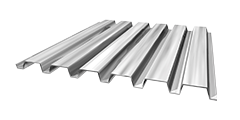
Galvanized steel composite floor decking sheet engineered profile
Permanent Formwork + Tensile Reinforcement

Two-Phase Structural Behavior in Composite Construction

Unlike non-composite permanent steel formwork that only bears wet concrete before becoming dormant, composite floor decking is roll-formed with deeply stamped embossed indentations along its web and flutes. These mechanical lugs lock permanently into the curing concrete slab.

Phase 1 (Construction Stage): The profiled steel sheet functions as a robust working platform and formwork, sustaining dead weight, wet concrete hydrostatic pressure, dynamic pouring impact, and worker loads without sagging, strictly governed by deflection limits of $L/180$ or $L/250$ with or without temporary propping.

Phase 2 (Composite Stage): Once the concrete attains design compressive strength ($f_{ck} \ge 25\text{–}35\text{ N/mm}^2$), the mechanical embossments create full or partial horizontal shear transfer. The profiled steel deck acts as the positive bottom tensile reinforcement, replacing conventional bottom rebar while distributing concentrated wheel or partition loads laterally.

Weight Reduction & Foundation Savings

Trapezoidal decking flutes displace subterranean concrete volume in the slab tension zone, reducing overall concrete weight by 20% to 35% compared to solid RC slabs. This mass reduction cascades downward, lowering column sizes, seismic shear forces, and foundation pile depths.

Elimination of Temporary Falsework & Stripping

Deep-rib deck profiles provide unpropped clear spans up to 4.5 meters. By eliminating wooden formwork, shores, re-propping cycles, and curing wait periods, fast-track contractors accelerate floor cycle times from 14 days down to 4 days per floor level.

Enhanced Diaphragm Seismic Ductility

When welded or mechanically fastened to structural steel beams with through-deck headed shear studs (shear connectors), composite decks create a continuous, rigid diaphragm that effectively transmits horizontal lateral wind and earthquake forces into core shear walls.

Integrated Services & Under-Floor Flexibility

The profile geometry accommodates suspension tabs, wedge nut hangers, and MEP containment without drilling into structural concrete, preserving acoustic and fire protection membranes while simplifying future interior tenant reconfigurations.

Engineered Profiles & Recommendations

Recommended Composite Floor Deck Specifications

Specifying the optimal floor decking profile depends on beam spacing, slab thickness, fire resistance rating (FRR), acoustic attenuation, and live load demands. PTI manufactures multiple configurations tailored to international project specifications.

Profile Model Profile Depth Cover Width Standard Thickness Steel Grade & Yield ($f_y$) Zinc Coating Options Recommended Application
PTI-Deck 45 / 50 45 mm – 51 mm 900 mm – 1000 mm 0.80 mm – 1.20 mm S350GD ($f_y \ge 350\text{ MPa}$) Z275 / Z350 (ASTM A653) Short-to-medium spans (1.8m – 2.8m), residential framing, hotel modules, multi-level car parks.
PTI-Deck 75 / 76 75 mm – 76 mm 820 mm – 915 mm 0.90 mm – 1.50 mm S350GD / S450GD Z275 / Z350 Large bay grids (3.0m – 4.5m unpropped), logistics centers, heavy commercial offices, mezzanines.
PTI Dovetail / Re-entrant 50 mm 600 mm – 750 mm 0.90 mm – 1.20 mm S350GD Z275 Architectural ceilings, tight ceiling voids, superior shear bond, acoustic-sensitive commercial slabs.
PTI Deep Rib 150 150 mm 600 mm 1.00 mm – 1.50 mm S450GD ($f_y \ge 450\text{ MPa}$) Z275 / Pre-painted Open-span parking decks, industrial loading bays, high-bay automated warehouse racking floors.

High-Rise Commercial Towers

Recommendation: PTI-Deck 75 in 1.0mm thickness, S350GD with Z275 coating. Combined with 19mm headed shear studs through-welded onto composite steel beams, this maximizes beam spacing up to 3.6m unpropped, minimizing primary steel tonnages.

Industrial & Logistics Mezzanines

Recommendation: PTI-Deck 75 / 76 in 1.2mm or 1.5mm thickness. Accommodates heavy forklift movements, high static pallet rack point loads, and vibration damping when paired with fiber-reinforced concrete.

Parking Garages & Marine Infrastructure

Recommendation: Heavy galvanized Z350 or coil-passivated structural steel decking. Mitigates chloride-induced corrosion from de-icing salts, marine airborne moisture, and cyclic vehicular dynamic stresses.

Fast-Track Modular Buildings

Recommendation: Precision pre-cut PTI-Deck 50 with factory bundle sequencing. Enables off-site cassette assembly or swift site laying with minimal field cutting and zero cranes occupied with timber shuttering.

Strategic Sourcing Intelligence

Global supply chains, digital engineering workflows, and stringent sustainability standards are reshaping how EPC contractors, steel fabricators, and commercial developers procure composite floor decking.

01

Decarbonization & Low-Embodied Carbon Steel

With Scope 3 carbon benchmarking becoming mandatory across North America, Europe, and GCC megaprojects (such as NEOM and regional green cities), decking procurement is shifting toward steel coils produced via Electric Arc Furnace (EAF) using direct reduced iron (DRI). Combining high-tensile lightweight profiles with low-carbon cement replacements (GGBS / Fly Ash) yields up to 40% reduction in total slab Global Warming Potential (GWP).
02

High-Yield Steel Upgrades (S450GD & S550GD)

Procurement directors are actively moving away from traditional lower-yield steels ($f_y = 250\text{–}280\text{ MPa}$) toward ultra-high-yield alloys ($f_y \ge 450\text{–}550\text{ MPa}$). By leveraging higher yield strengths, design engineers reduce nominal steel thickness from 1.2mm to 0.9mm without compromising section modulus or wet-deck deflection limits, saving up to 20% in freight weight and raw material expenditure.

03

Digital BIM-Driven Automated Fabrication

Standard random-length stock procurement is giving way to Direct-from-Model cut schedules. Deck manufacturers receive Tekla or Revit structural models to roll-form exact cut-to-length sheets bundled per grid line, level, and pour sequence. This slashes on-site scrap from the historical 6%–8% down to under 1%, speeding erection and reducing site waste handling hazards.

04

Advanced Corrosion Coatings (Zn-Al-Mg)

While hot-dip zinc Z275 remains the global benchmark, advanced ternary alloy coatings containing Zinc, Aluminium, and Magnesium (e.g., ZM310) are emerging rapidly. These self-healing coatings provide up to 3 to 4 times higher salt-spray corrosion resistance than pure zinc coatings, expanding unpainted decking use in high-salinity coastal areas across the Arabian Gulf and Indian Ocean rims.

05

Supply Chain Diversification & Middle East Nearshoring

Fluctuating ocean container spot rates and regional geopolitical chokepoints have compelled tier-1 EPC contractors to move away from volatile single-region suppliers. Sourcing from Oman-based integrated manufacturers like Paneltech International provides direct deep-water port access (Sohar, Sultan Qaboos, Salalah), offering shortened freight transit to the GCC, East Africa, South Asia, and the Mediterranean.

06

Turnkey Single-Source Envelope Procurement

Contractors increasingly bypass fragmented sub-tier vendors in favor of integrated envelope manufacturers capable of supplying the composite floor decking along with structural cold-formed Z & C purlins, insulated PIR wall panels, and profile roof sheets under a single unified warranty, synchronized logistics plan, and verified QA regime.

Evolution of Composite Structural Systems

Engineering Innovations in Modern Floor Decking

The progression from early flat-bottom corrugated formwork to today's highly engineered shear-bond composite decks reflects decades of advances in cold-roll forming, finite element analysis, and empirical testing.

Chevron Embossments

Micro-grooved chevron and diamond patterns cold-formed into the vertical webs create continuous mechanical interlocking, preventing end slip and yielding higher $m$ and $k$ bond values under Eurocode 4.

Optimized Rib Geometry

Re-entrant dove-tail profiles and stiffened trapezoidal ribs resist local buckling under wet concrete weight, enabling longer unpropped clear spans while optimizing concrete volume efficiency.

Calculated Fire Slabs

Fire engineering methodologies enable slabs to sustain ISO 834 fire curves up to 4 hours without sprayed insulation, relying on deck tensile membrane action and embedded reinforcement within troughs.

Automated Roll-Forming

Multi-stand precision roll-forming lines maintain flange squareness, web symmetry, and pitch tolerances within ±2mm, ensuring air-tight and concrete-tight side overlaps that prevent slurry leakage.

Enterprise Manufacturing Authority

Why Global Contractors Partner with Paneltech International

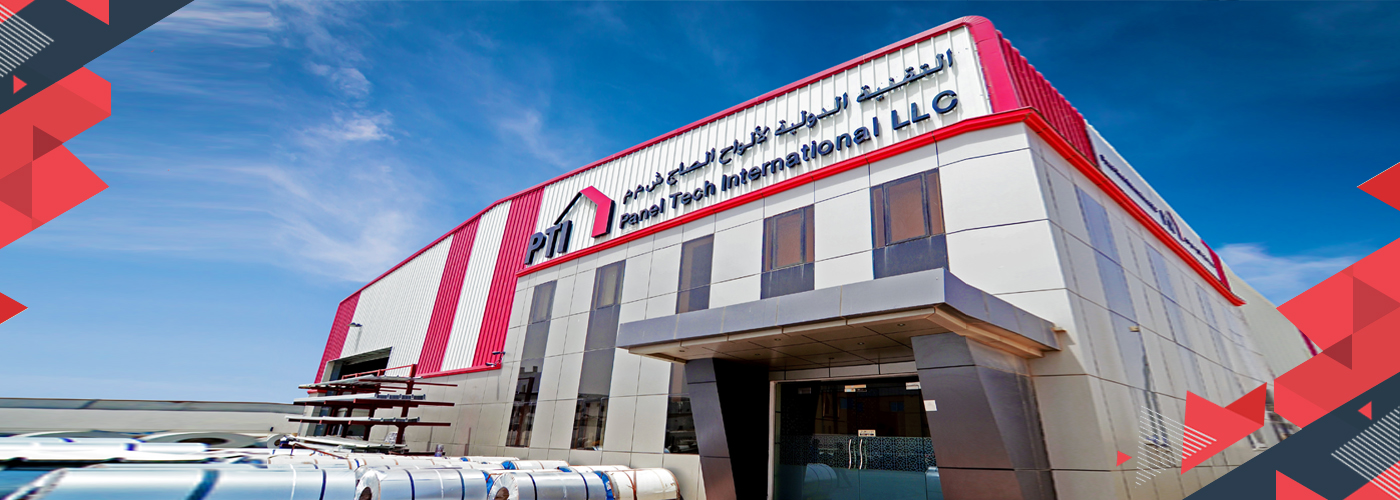
Since 2009, Paneltech International LLC (PTI) has operated from Barka, Sultanate of Oman, as a recognized manufacturer of composite metal decking, insulated sandwich panels, cold-formed purlins, and industrial envelope systems.

Barka, Sultanate of Oman Production Hub

Verified Production Capacity & Quality Governance

Procuring composite decking for major infrastructure demands absolute reliability in steel chemical composition, yield consistency, and galvanizing adhesion. At our dedicated manufacturing facility in Barka, we enforce rigorous production controls:

  • Prime Certified Coils: Sourced strictly from global ISO 9001-certified primary steel mills with 3.1 Mill Test Certificates verifying ASTM A653 / EN 10346 mechanical parameters.
  • Continuous In-Line Roll-Forming: High-precision automated rolling lines designed specifically to cold-stamp high-definition shear embossments without micro-cracking the zinc protective layer.
  • Integrated Building Envelope Package: Ability to coordinate composite decking with PTI Z & C structural purlins, PIR roof/wall sandwich panels, flashings, and industrial roller shutter doors.
  • Direct Technical Support: In-house structural engineering teams providing deck section modulus tables, allowable unpropped span calculations, and concrete slab load-span design assistance.
Get Catalog
Paneltech International manufacturing facility Barka Oman

Proven Across Landmark Projects in the Sultanate & GCC

City Center Sohar project reference

City Center Sohar

Extensive retail and commercial envelope delivery featuring composite floor assemblies and heavy-duty structural sheeting.

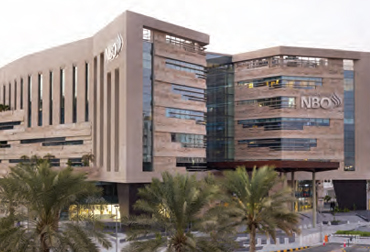
Head Office National Bank of Oman

National Bank of Oman Head Office

Prestige banking headquarters utilizing premium engineered structural components and floor decking systems.

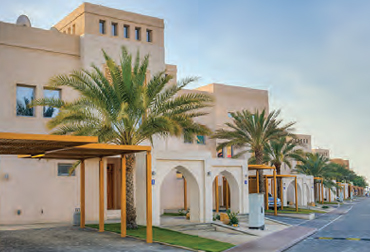
Ras Al Hamra residential community project

Ras Al Hamra Community

Residential and recreational infrastructure engineered with high-durability galvanized materials for coastal longevity.

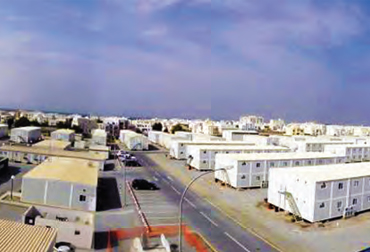
Airport site staff accommodation facility

Airport Infrastructure Sites

Large-scale fast-track building envelopes requiring verified fire rating, thermal performance, and zero-defect delivery.

Technical Procurement Knowledge

Composite Floor Decking: Frequently Asked Questions

In-depth structural and commercial answers to the most common queries asked by procurement directors, consulting engineers, and BIM specialists.

Composite floor decking functions in two distinct phases: during construction, it acts as a robust, non-combustible permanent working platform and formwork supporting wet concrete, reinforcement, and dynamic construction live loads without requiring intermediate timber shoring. Once the concrete cures, mechanical embossments pressed into the profile web and flanges develop mechanical interlocking and shear bond resistance with the concrete matrix. Under Eurocode 4 (EN 1994-1-1) and ANSI/SDI C-2017, the steel decking acts as the primary positive tensile reinforcement at mid-span, eliminating bottom rebar, reducing total dead load, and significantly shortening construction schedules.

The mechanical bond strength between hardened concrete and the cold-formed steel deck governs horizontal shear transfer. Without embossments, smooth steel exhibits minimal friction, leading to premature longitudinal slip and slab delamination under flexural loading. Profile ribs engineered with chevron, herringbone, or trapezoidal indentations create mechanical bearing pockets. In structural design calculations, this performance is validated through empirical $m-k$ shear-bond tests or the partial shear connection method ($\tau_{u,Rd}$), determining the maximum ultimate vertical load capacity and allowable unpropped spans for each specific gauge and profile.

For standard enclosed interior commercial office slabs in dry conditions (ISO 12944 atmospheric corrosivity category C1/C2), a standard hot-dip zinc coating of Z275 (275 g/m² total mass both sides, approximately 20 microns per side) delivers an expected service life exceeding 50 years. For exposed industrial plants, high-humidity coastal structures, open-sided multi-story car parking garages, or chemical storage facilities (C3/C4 environments), procurement teams should specify Z350 (350 g/m²) or continuous Zinc-Aluminium-Magnesium alloys, backed by passivated surface treatments to resist oxidation during marine transit and concrete cure.

Yes. Composite floor slabs can be engineered to achieve fire resistance periods from 60 minutes (REI 60) up to 240 minutes (REI 240) in accordance with BS EN 1994-1-2 and BS 5950 Part 8. Fire resistance is governed primarily by overall slab depth (ensuring insulation criteria to prevent temperature rise on the unexposed upper floor face), minimum concrete cover over the profile crests, welded crack control mesh (e.g., A142 / A193 / A252), and bar reinforcement placed in the deck troughs. During fire exposure, while the exposed steel profile may lose yield strength, the trough rebar and concrete tensile membrane action preserve structural integrity without collapse.

A solid reinforced concrete flat slab requires concrete across its entire depth, adding massive dormant self-weight in the lower tension zone where concrete provides zero tensile strength. With a trapezoidal composite deck (such as PTI-Deck 75), the steel troughs replace concrete in the tension zone. This geometry reduces total concrete volume by 0.05 to 0.09 m³ per square meter of floor slab. For a 20,000 m² commercial project, this equates to roughly 1,400 m³ less concrete poured, reducing dead load by over 3,300 tons, which directly downsizes primary structural steel beam sections, columns, transfer trusses, and foundation piling depths.

Procurement teams and consulting engineers must mandate: (1) EN 10204 Type 3.1 Mill Test Certificates verifying base steel chemistry (Carbon, Manganese, Phosphorus, Sulfur content) and mechanical yield ($R_e$), tensile strength ($R_m$), and elongation ($A_{80}$); (2) Zinc coating mass verification tests according to ASTM A90 or ISO 1460; (3) Dimensional tolerance inspection reports verifying pitch, depth, and cover width per EN 1090-2 or ANSI/SDI C-2017; and (4) Seaworthy packaging inspection with moisture-barrier wrapping and timber dunnage to avoid transit white rust formation.

Factory-Direct Technical Proposal

Ready to Optimize Your Structural Floor Slab Design?

Partner with Paneltech International LLC for precision roll-formed composite floor decking, cold-formed purlins, and full building envelope solutions manufactured to international standards in Barka, Sultanate of Oman.

Get Catalog Request Technical Data Sheet

Call Direct

+968 97649430
+968 26881135
+968 26881136

Manufacturing Plant

Panel Tech International LLC
P.O. Box 391, PC 320, Barka
Sultanate of Oman