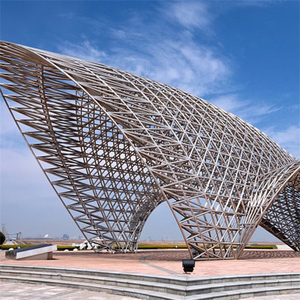
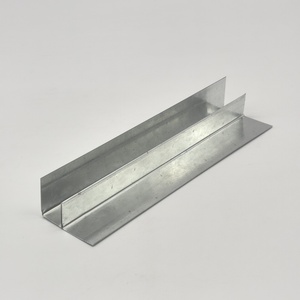
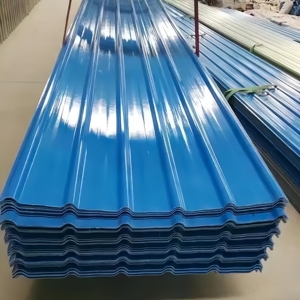
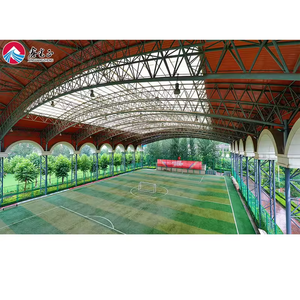
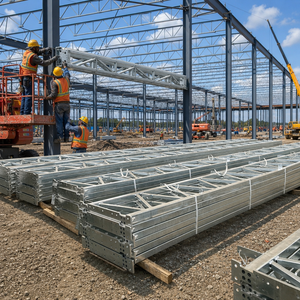
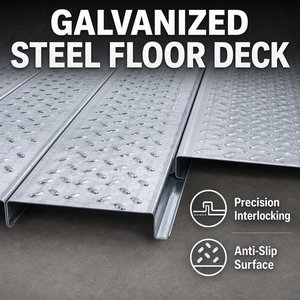
Precision-manufactured building systems spanning high-strength galvanized roofing substrates, long-span stadium space frames, composite floor decking, and clean-span daylighting panels.
In global structural building envelopes, specifying galvanized corrugated roofing sheets is an exercise in applied metallurgy, atmospheric corrosion chemistry, and finite mechanical load profiling. Procuring engineers must navigate across conflicting demands: balancing tensile yield thresholds under intense cyclic wind suction versus maintaining adequate ductility for cold roll-forming lines without micro-fissuring the protective metallic layer.
The core substrate selection determines the fundamental load-deflection ratio over long structural purlin spans. Modern manufacturing uses continuous hot-dip zinc-coated flat products conforming to stringent international standards, notably ASTM A653/A653M (CS Type B, FS Type B, SS Grade 33 to Grade 80) and BS EN 10346 (DX51D+Z through S550GD+Z). For long-span industrial corrugated applications, our Barka, Oman manufacturing lines configure cold-rolled structural steel substrates with yield strengths reaching S350GD (350 MPa minimum yield) and S550GD (550 MPa ultra-high tensile yield), providing roof structures with superior hail-strike resilience and resistance against negative gust pressures up to 3.2 kPa.
Specifiers must resist the procurement error of substituting commercial light zinc deposits (Z60 to Z100) for severe environment roof cladding. Atmospheric zinc corrosion rates in high solar irradiance, marine salinity zones (such as GCC coastlines or Southeast Asian marine belts) range from 2.1 to 8.4 µm per year. Paneltech International LLC enforces strict adherence to heavy coating schedules—ranging from Z180 (180 g/m² total both sides) to Z275 (275 g/m² / ~20 µm per surface) and specialized Zinc-Aluminum-Magnesium (ZAM / Zn-Al-Mg) continuous coatings that form insoluble zinc hydroxychloride and simonkolleite patina buffers, self-healing shear-cut edges and punched fixing holes.
| Alloy / Coating Specification | Standard Mass Range | Yield Strength Range | Atmospheric Class (ISO 12944) | Estimated Service Life to 5% Red Rust |
|---|---|---|---|---|
| Continuous Hot-Dip HDG (Z180) | 180 g/m² (total both sides) | 280 – 350 MPa | C2 to C3 (Dry Urban/Light Industrial) | 12 – 18 Years |
| Heavy Structural HDG (Z275) | 275 g/m² (total both sides) | 350 – 550 MPa | C3 to C4 (Coastal & Chemical Environs) | 25 – 35 Years |
| Galvalume 55% Al-Zn (AZ150) | 150 g/m² (total both sides) | 300 – 550 MPa | C3 to C4 (High Solar Heat Reflection) | 30 – 45 Years (Avoid Marine Halides) |
| Zn-Al-Mg Super Barrier (ZM250) | 250 g/m² (total both sides) | 350 – 550 MPa | C5-I / C5-M (Marine Heavy Industrial) | 50+ Years (Superior Edge Self-Healing) |
Tailoring profile geometries, rib depths, coil slit tolerances, and protective clear chemical passivations to exact project architectural requirements.
Multi-stage cold roll forming creates sinusoidal (corrugated round crest) and trapezoidal box-rib profiles (depths from 18mm to 45mm, pitch from 65mm to 250mm). We engineer crest capillary grooves into overlap seams to eliminate wind-driven siphon leakage under flash flooding conditions.
Our Barka plant utilizes flying hydraulic shears synchronized with programmable encoder logic. We supply sheet lengths up to 13.6 meters with tight tolerance limits of ±2mm, eliminating transverse site laps on industrial portal sheds and cutting field installation labor by up to 35%.
Continuous mill lines apply trivalent chrome-free (Cr3+ free) chemical passivation and light electrostatic oiling. This treatment prevents transit humid oxidation, commonly known as wet-storage white rust (zinc carbonate degradation), throughout open sea container voyages.
The global metallic building envelope market is transitioning away from conventional raw-tonnage purchasing toward multi-dimensional specification audits. Driven by carbon tariffs, advanced alloy development, high-frequency extreme weather events, and roof-mounted solar integrations, international procurement directors must factor five critical macro trends into their purchasing roadmaps:
The European Union's Carbon Border Adjustment Mechanism (CBAM) and corresponding global carbon border accounting frameworks have made verified Environmental Product Declarations (EPDs) compulsory for structural steel imports. Procurement tenders now prioritize galvanized sheet manufacturers powered by scrap-based Electric Arc Furnaces (EAF) or hydrogen-reduced iron (DRI), replacing high-emission blast furnace (BF-BOF) profiles to protect developers from sudden carbon border adjustment tariffs.
Standard pure-zinc hot dip (Z275) is rapidly being superseded on engineering schedules by ternary Zinc-Aluminum-Magnesium (ZAM / Zn-Al-Mg) systems. Magnesium acts as a chemical catalyst that alters zinc patina from porous zinc carbonate to tightly adherent Simonkolleite. This crystalline structure delivers cut-edge corrosion resistance 4 to 10 times higher than classic HDG at equal coating thickness, lowering lifecycle maintenance costs across industrial, chemical, and coastal structures.
With industrial and commercial rooftop solar arrays becoming mandatory or economically essential, galvanized roofing sheets must serve as durable foundations for 25-year photovoltaic systems. Modern profiles feature reinforced standing-seam crowns and rib flats designed for direct-clamp, non-penetrating solar hardware. Eliminating screw penetrations maintains factory thermal seals and preserves envelope weather-tightness over decades of operation.
Geopolitical shipping chokepoints and container freight volatility have elevated the value of regional manufacturing hubs with deep-water access. Tier-1 buyers increasingly favor single-source suppliers like Paneltech International in Oman, sourcing secondary structural members (Z & C purlins), composite floor decks, metal flashings, and insulated sandwich panels in balanced shipping containers, maximizing freight density while reducing procurement coordination overhead.
Operating continuously since 2009, Paneltech International LLC provides international contractors with fully certified, integrated building envelope manufacturing backed by independent laboratory testing and global logistics reach.
Avoid coordinating separate vendors for roof sheets, cold-formed sub-structures, and hardware. We manufacture matching corrugated profiles, composite floor decking, heavy cold-rolled C/Z purlins, profile-matched FRP skylights, and flashings from identical master coils, guaranteeing uniform paint shades, consistent galvanizing metallurgy, and seamless on-site assembly.
Products engineered to perform in Oman's demanding coastal climate—where metal roofs face ambient summer temperatures exceeding 48°C, 85%+ relative humidity, high salt spray deposition, and intense solar UV index levels up to 12. Our heavy zinc mass and oven-cured finishes resist chalking, blistering, and premature structural oxidation far longer than generic commercial-grade alternatives.
Every production run leaves our Barka factory backed by comprehensive inspection certification to EN 10204 3.1. We provide heat-lot chemical ladle analyses, yield and elongation mechanical pull-test results, gravimetric zinc mass verification reports, and salt spray chamber test documentation, simplifying client audits and third-party consultant sign-offs.
Clear, practical guidance on coating calculations, wind load mechanics, thermal dynamics, and shipping protocols for structural engineers and project buyers.
Determining the optimal zinc coating mass requires evaluating the project site's ISO 12944 atmospheric corrosivity category (C1 through C5-M). In standard dry inland environments (C2), a Z180 (180 g/m² total both sides, providing roughly 13 µm of barrier zinc per surface) will easily provide an operational lifespan exceeding 20 years. However, for industrial sites with sulfur dioxide exposure (C4) or marine facilities located within 3 km of seawater (C5-M), zinc sacrificial consumption rates often reach 2.5 to 5.0 µm per year. For these demanding installations, specifying a minimum of Z275 (20 µm per side) or modern Zinc-Aluminum-Magnesium (ZM200-ZM250) is required to prevent red rust formation within design warranty cycles. Factor in prevailing wind directions, seasonal humidity levels, and nighttime condensation cycles, which accelerate electrolyte formation on unwashed under-eave profiles.
The core distinction lies in mechanical yield strength and metallurgical elongation. DX51D is a commercial-grade, formable mild steel with no guaranteed minimum structural yield strength (though typical yield hovers around 180–240 MPa). It is easy to roll-form into complex profiles and flashing trims, but offers limited resistance to live loads and negative wind suction. Conversely, S350GD provides a certified minimum yield strength of 350 MPa, while S550GD delivers a minimum yield of 550 MPa. In practical envelope design, using high-yield S350GD or S550GD steel lets structural engineers safely widen purlin spacing (from 1.2m to 1.8m or more) while maintaining code compliance for live loading, deflection limits (L/200), and cyclic hurricane suction without permanent plastic panel deformation.
Carbon steel has a coefficient of thermal linear expansion of approximately 12 × 10⁻⁶ m/m/°C. On a continuous 12-meter single-length roofing sheet subject to surface temperature shifts from winter morning lows of 10°C to summer solar-heated peaks of 75°C (a ΔT of 65°C), the overall linear dimensional shift is approximately 9.36 mm. If long sheets are rigidly through-fastened without provision for thermal travel, fastener shanks can fatigue, tear through the metal gauge, and cause roof leaks. To accommodate this movement, specify oversized pre-drilled fastener holes (using EPDM bonded washers) for through-fixed trapezoidal sheets, or deploy concealed-fix standing seam profiles with floating thermal movement clips that let the roof skin expand and contract freely along the fall line without fatiguing primary structural fasteners.
Direct metallic contact between galvanized steel and dissimilar metals can cause severe bimetallic (galvanic) corrosion when moisture is present. While zinc and aluminium have relatively close galvanic potentials in mild environments, direct runoff of water from copper piping, copper flashing, or bare lead flashings onto galvanized sheets will trigger rapid pitting and perforation of the zinc coating within months. Similarly, direct contact with preservative-treated timber containing copper azole (CA-B) or alkaline copper quaternary (ACQ) compounds will quickly corrode hot-dip galvanized steel. Always isolate dissimilar metals and treated lumber using non-conductive, self-adhesive bituthene membranes, EPDM thermal isolation tapes, or thick neoprene barrier gaskets.
White rust occurs when tightly nested galvanized steel sheets are exposed to humid air, trapped moisture, or condensation in the absence of free-circulating atmospheric oxygen. Under these conditions, the zinc surface cannot convert into its stable, protective zinc carbonate patina, forming a voluminous white zinc hydroxide powder instead. Paneltech mitigates transit oxidation through a 4-tier protection protocol: (1) in-line application of hexavalent-free chemical passivation baths; (2) precision electrostatic oiling using rust-preventative mill oils; (3) automated wrapping in heavy vapor-corrosion-inhibitor (VCI) paper reinforced with heavy polyethylene outer shrink wrap; and (4) packaging on raised longitudinal fumigated timber bearers banded with high-tensile steel straps, including multi-stage container desiccants to prevent sweat cycles during container sea freight across changing climate zones.
Every commercial export order includes a formal EN 10204 Type 3.1 Inspection Certificate verified by our quality control metallurgy division. This documentation package records: full chemical heat analysis (C, Mn, Si, P, S, Al content); mechanical testing metrics (Upper and Lower Yield Strength, Tensile Strength, Total Elongation percentage, and 180° Cold Bend test results); gravimetric triple-spot zinc coating mass verification (g/m²); dry film thickness (DFT) paint reports for pre-painted orders; and profile dimension tolerance sheets verified against ASTM A924 and EN 508 standards. On custom projects, we also facilitate third-party inspector audits (SGS, Bureau Veritas, or TÜV) for independent pre-shipment sampling and testing.
Connect with our senior facade engineering and procurement specialists in Barka, Oman. Receive comprehensive technical submittals, custom roll-forming CAD schedules, and direct factory pricing within 24 hours.