
High-performance sound-absorbing, composite-core insulated panels engineered for sports arenas, industrial powerhouses, acoustic enclosures, cold chain warehouses, and high-spec architectural ceilings.
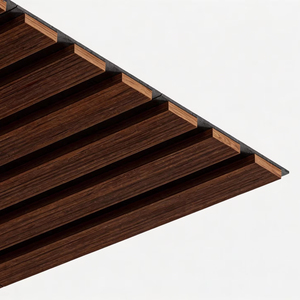
Engineered for interior acoustic absorption and reverberation reduction. Combines high-density recycled acoustic fleece with precision-slatted wood veneer for studios, boardrooms, and commercial auditoriums.

Micro-perforated inner steel facing combined with high-density oriented basalt rock wool (120kg/m³). Eliminates flutter echo while delivering non-combustible building envelope defense.
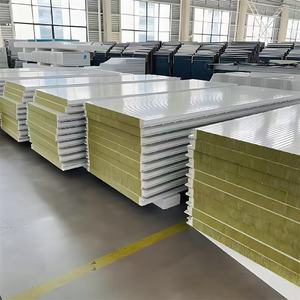
Heavy-duty structural roof panels designed to decouple rain impact noise and airborne machinery roar. Engineered with water-repellent mineral wool core and corrugated outer trapezoidal ribs.
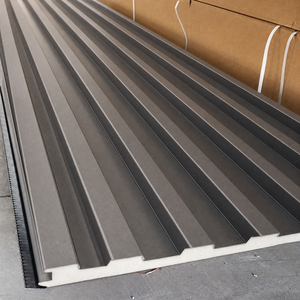
Combines closed-cell polyurethane rigidity with continuous acoustic sealing tongue-and-groove joints. Provides exceptional dampening against environmental street noise and thermal loss.
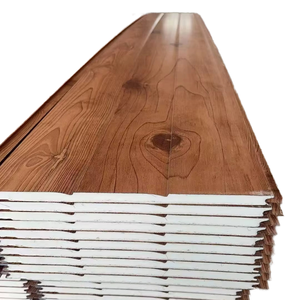
Ultra-dense polyisocyanurate and polyurethane composite envelope preventing compressor reverberation transfer while upholding sub-zero cryogenic insulation integrity.
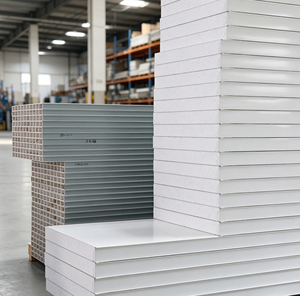
Seamless flush-joint composite foam panel system engineered for pharmaceutical, semiconductor, and laboratory installations requiring both airborne sound abatement and zero particulate release.
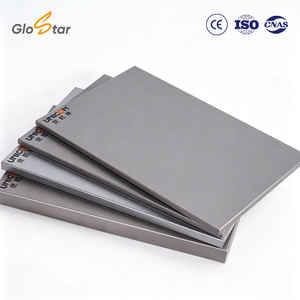
Aerospace-grade hexagonal honeycomb core laminated between micro-perforated aluminum alloys. Designed for cinema complexes, opera halls, and corporate headquarters seeking wide spans without deflection.
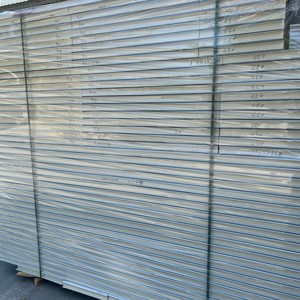
Dual-action fire barrier and acoustic separation partition with vertically oriented fiber orientation. Delivers maximum structural shear strength, sound barrier separation, and ASTM/EN certification.
Modern architectural and industrial construction demands far more than basic thermal resistance ($U$-value). With urban industrial zones expanding closer to municipal centers, sports arenas operating adjacent to commercial districts, and internal manufacturing acoustics subject to stringent OSHA and ISO 1999 occupational noise directives, building envelope specifications have undergone a fundamental paradigm shift.
An acoustic sandwich panel operates on sophisticated multi-physics principles: mass-spring-mass resonance dampening, resonant cavity dissipation, and viscous acoustic boundary layer friction. Unlike standard double-skin metal cladding where acoustic bridging creates severe resonance and flanking transmission, factory-engineered acoustic panels employ decoupled steel skins, high-density non-combustible fibrous basalt (Rockwool), elastomeric continuous adhesive matrixes, and precision micro-perforations backed by sound-transparent acoustic veil fleece (such as SoundTex).
"Specifying acoustic sandwich panels without verified laboratory test reports (ASTM E90 / ISO 10140-2) is the single greatest cause of building acoustic failure in industrial envelopes. Transmission loss is non-linear: a drop of just 3 dB in acoustic attenuation represents a doubling of perceived sound energy passing through the building envelope."
Evaluating an international acoustic sandwich panel supplier requires reviewing continuous manufacturing capabilities, acoustic testing credentials, core bonding resins, regional fire safety approvals, and export packaging reliability. Below is our industry-verified ranking of the top 10 acoustic sandwich panel factories and export manufacturers serving international mega-projects.
Operating since 2009 in Barka, Paneltech International LLC is recognized as a premier manufacturer of high-spec PIR, PU, and Rockwool sandwich panels. PTI's specialized acoustic rock wool panels feature automated micro-perforated lines, sound-absorbing acoustic scrims, and complete building envelope integration (including cold-formed purlins, decking, and flashings). Backed by ISO certifications, third-party acoustic testing, and extensive export logistics across the Middle East, Africa, and global territories.
A global market heavyweight known for QuadCore technology and specialized acoustic wall solutions. Delivers extensive laboratory data, broad international presence, and high-performance panel envelope systems specified in tier-one global infrastructure.
Renowned for premium stone wool core sandwich panels delivering superior fire protection and acoustic dampening. Paroc's acoustic panel range is widely utilized in power stations, sports arenas, and industrial manufacturing plants throughout Europe.
A pioneer in sandwich panel continuous laminating lines with multiple manufacturing sites across Europe, Latin America, and Asia. Supplies perforated sound-absorbing roof and wall panels under the Hi-Fi and Metacoustic brand classifications.
Specializes in Nordic-grade steel building envelopes with verified acoustic sound reduction values up to Rw 32-42 dB. Integrates airtight joint seals that eliminate acoustic flanking through perimeter seams.
Leveraging deep metallurgy expertise, ArcelorMittal produces composite sound insulation panels with mineral fiber infill and aesthetic micro-ribbed finishes, engineered for acoustic facade isolation and noise barriers.
One of the largest European producers of insulating metal panels for roofs and walls. Their specialized acoustic line, Isofire Acoustic, features perforated steel facings for high acoustic absorption (NRC) in noisy industrial settings.
Creator of the Qbiss One and trimoterm architectural panel systems, Trimo combines modular design with non-combustible mineral wool insulation to provide high acoustic dampening for aviation, cultural, and logistics centers.
A key Central European exporter delivering mineral wool sandwich panels engineered for sound reduction in warehouses, processing factories, and cold storage hubs with robust European testing compliance.
Major Asian exporter providing continuous line rock wool and PU acoustic panels for massive industrial infrastructure, mega cleanrooms, and automated factory enclosures worldwide.
Selecting the optimal acoustic sandwich panel requires navigating the critical trade-offs between core material mass, cellular structure, thermal conductivity, and fire reaction. The table below outlines empirical performance metrics across standardized test procedures (ISO 717-1 / ASTM E413):
| Panel Core Type | Core Density | Acoustic Sound Reduction (Rw) | Sound Absorption (NRC) | Thermal Cond. (λ) | Euroclass Reaction to Fire | Optimal Engineering Application |
|---|---|---|---|---|---|---|
| Perforated Rockwool | 100 - 130 kg/m³ | Rw 34 - 42 dB | NRC 0.85 - 0.95 | 0.038 - 0.042 W/m·K | Class A1 / A2-s1,d0 | Sports Arenas, Power Stations, Compressor Rooms, Ice Rinks |
| Solid Core Rockwool | 100 - 140 kg/m³ | Rw 32 - 36 dB | NRC 0.15 - 0.25 | 0.039 - 0.044 W/m·K | Class A1 Non-Combustible | Fire Separation Walls, Industrial Roof Rain-Noise Decoupling |
| Polyisocyanurate (PIR) | 38 - 42 kg/m³ | Rw 24 - 28 dB | NRC 0.10 - 0.15 | 0.020 - 0.022 W/m·K | Class B-s1,d0 / B1 | Cold Storage Facilities, Food Logistics, High-Thermal Envelopes |
| Polyurethane (PU) | 36 - 40 kg/m³ | Rw 23 - 26 dB | NRC 0.10 - 0.15 | 0.022 - 0.024 W/m·K | Class B2 / B3 | Cost-Optimized Commercial Warehouses, General Enclosures |
| Aluminum Honeycomb | Varies (Cell 6mm) | Rw 28 - 35 dB | NRC 0.75 - 0.90 | Conductive (Requires Barrier) | Class A1 Flameproof | Cinema Halls, High-End Corporate Interiors, Rail Interiors |
Established in 2009 in the industrial center of Barka, Sultanate of Oman, Paneltech International LLC (PTI) operates one of the most advanced continuous sandwich panel and roll-forming installations in the Middle East. Engineering consultants and EPC contractors across the GCC and international export markets rely on PTI for several decisive advantages:
Unlike simple panel converters, Paneltech manufactures sandwich panels, corrugated profile sheets, metal decking sheets, cold-formed structural Z & C purlins, architectural flashings, and industrial roller shutter doors under one roof, guaranteeing precision tolerances and profile color matching.
PTI building envelope products are specified on high-profile installations including City Center Sohar, the National Bank of Oman Head Office, Ras Al Hamra Residential Complex, Royal Oman Police facilities, and international aviation sites.
Situated adjacent to deep-water shipping corridors in Oman, Paneltech supplies containerized and break-bulk sandwich panel packages across Saudi Arabia, UAE, Qatar, Kuwait, Africa, and transcontinental destinations with sea-worthy protective packaging.
Driven by carbon accounting standards (Scope 3 emissions), modular off-site construction, and tightening workplace acoustic legislation, the next generation of acoustic panels is evolving beyond standard mass-heavy designs:
Sub-millimeter laser perforations create acoustic impedance without exposing mineral fibers. This innovation allows fiber-free acoustic dampening suitable for high-sanitation cleanrooms, food factories, and hospital envelopes.
Manufacturers are transitioning from petroleum-exclusive polyols to agricultural lignin and recycled PET-derived foaming chemistry, reducing the embodied carbon of sandwich panel cores by up to 35% without degrading acoustic dampening.
Architectural engineering workflows now require panel manufacturers to supply complete Building Information Modeling (BIM) objects with native frequency-dependent insertion loss data, accelerating acoustic compliance sign-off.
Technical guidance for structural engineers, acoustic consultants, and procurement managers evaluating factory bids.
Both metrics measure airborne sound transmission loss across a building partition, but they are derived from different regional test standards. Rw (Weighted Sound Reduction Index) is governed by international ISO standards (ISO 717-1 / ISO 10140-2) and covers frequencies between 100 Hz and 3150 Hz, frequently accompanied by spectrum adaptation terms ($C$ and $C_{tr}$) to account for pink noise and urban traffic noise. STC (Sound Transmission Class) is governed by American ASTM standards (ASTM E90 / ASTM E413) and evaluates transmission loss from 125 Hz to 4000 Hz. While numerical values are frequently close (e.g., an Rw of 35 dB often correlates to an STC of 34-36), international projects must specify the governing standard to ensure regulatory compliance.
A solid metal sandwich panel primarily acts as a mass barrier—reflecting incident sound waves back into the space while mitigating sound transmission through the other side. A perforated acoustic panel features thousands of micro-apertures on the internal skin backed by an acoustic non-woven fleece (SoundTex). Incident sound pressure waves enter these perforations, causing micro-turbulent friction against the non-woven fleece and the porous open-fiber network of the basalt rock wool core. This converts acoustic kinetic energy directly into low-grade thermal dissipation, dramatically reducing internal room reverberation (achieving high NRC ratings of 0.85-0.95) while retaining structural panel integrity.
Even if an individual sandwich panel tests at an exceptional Rw 42 dB in a certified acoustic laboratory, the finished wall or roof assembly may underperform if flanking paths exist. Flanking transmission occurs when sound bypasses the acoustic panel through structural steel framing, unsecured panel interlocking tongues, perimeter wall-to-floor junctions, or unsealed penetrations. To preserve laboratory-level performance, installers must specify continuous resilient acoustic gaskets, factory-applied sealant beads within tongue-and-groove joints, and dense acoustic mineral wool packing at all perimeter flashings.
The standard density for acoustic rock wool cores ranges between 100 kg/m³ and 130 kg/m³. If the density is too low (<80 kg/m³), the panel lacks the physical mass required to prevent low-frequency airborne sound transmission, and structural shear strength across wide purlin spans is compromised. If the density is excessively compressed (>150 kg/m³), the internal pore structure of the stone wool closes, reducing high-frequency sound absorption (NRC). Paneltech International balances automated continuous strand orientation to achieve optimal mass-to-porosity ratios, maximizing both mechanical span ratings and broad-band acoustic damping.
PIR and PU panels feature closed-cell foam matrices designed for low thermal conductivity (λ ~ 0.022 W/m·K). However, closed-cell foams lack the porous fiber structure required for high sound absorption, typically offering an NRC below 0.15. While a 100mm PIR panel provides moderate airborne sound transmission loss (Rw ~ 25-27 dB) due to the mass of the exterior steel skins, it cannot control internal room reverberation or echo. For environments requiring both high thermal insulation and acoustic quietness (such as food processing facilities or compressor plants), composite dual-core panels (PIR combined with an internal rock wool acoustic facing) are specified.
Export sandwich panels are vulnerable to surface abrasion, transit moisture ingress, and fork-lift impact during intermodal shipping. High-volume exporters like Paneltech International apply protective peel-off polyethylene films on all pre-painted steel facings, bundle panels with edge-protecting EPS cushioning blocks, shrink-wrap bundles in UV-stabilized heavy poly-sheeting, and pack them on solid timber runners designed for container roller-extraction. Desiccant packs are inserted to neutralize container rain during trans-oceanic passage across varying climatic zones.
Procurement bids must require: (1) Third-party laboratory acoustic transmission loss test reports (ISO 10140-2 / ASTM E90) and absorption reports (ISO 354 / ASTM C423); (2) Reaction-to-fire certificates from accredited labs (e.g., EN 13501-1 Class A1/A2 or ASTM E84 Class A); (3) Mill test certificates for the steel substrates verifying zinc coating thickness (e.g., Z275 / AZ150) and topcoat paint performance (PVDF or SMP); and (4) Manufacturer quality assurance verification (ISO 9001:2015).
Yes. A primary advantage of sourcing with Paneltech International LLC is our complete building envelope capability. In addition to continuous acoustic sandwich panel manufacturing, PTI operates precision CNC press brakes for custom architectural and acoustic flashings, roll formers for structural Z and C purlins, and specialized metal decking lines. This enables contractors to procure the entire roof, wall, acoustic partition, and secondary framing system from a single verified manufacturer with single-source accountability.
Whether you require Rw 42 dB sports hall acoustic walls, non-combustible A1 fire-rated rock wool factory partitions, or complete envelope packages including purlins and flashings, our engineering team in Barka, Oman delivers verified technical proposals within 24 hours.