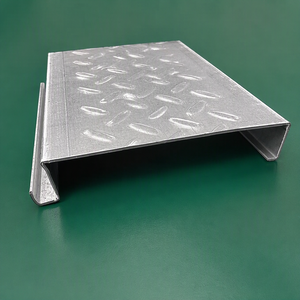
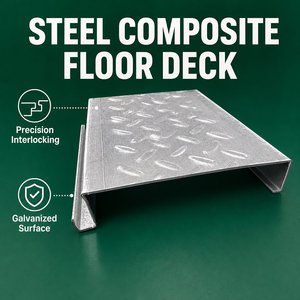
Galvanized Composite Floor Deck | Concrete-Free Steel Deck for Pre-Engineered Building Multi-Storey Floor Systems
- Yield Strength: 350 to 550 MPa
- Zinc Coating: Z120 - Z275 g/m²
- Application: PEB Multi-Storey Flooring
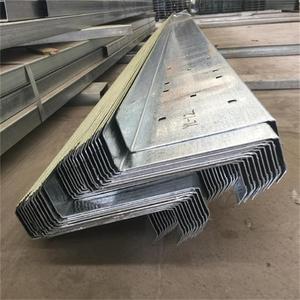
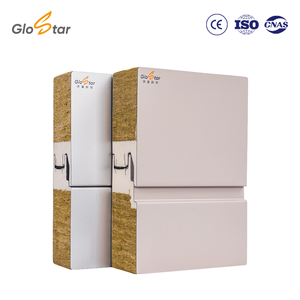
Direct procurement of precision-profiled daylighting panels, fire-rated insulated sandwich panels, cold-formed structural steel purlins, and industrial composite floor deck systems engineered to international ASTM/EN/BS standards.
Why leading architectural engineers, EPC contractors, and steel structure fabricators are migrating toward precision-extruded translucent systems that integrate seamlessly with secondary steel frames and insulated sandwich envelopes.
In the modern era of Pre-Engineered Buildings (PEB), industrial warehousing, and aviation hangars, the selection of translucent daylighting panels is no longer a simple matter of choosing corrugated plastic sheets. Daylighting directly dictates the thermodynamic balance, life-cycle structural durability, and energy consumption metrics of large-span facilities. Premium skylight roofing systems engineered by tier-one Chinese factories and international manufacturing consortiums (such as Paneltech International LLC with operations in Barka, Oman) are designed to solve four critical building physics challenges: thermal bridge mitigation, long-term UV photochemical oxidation, dynamic wind uplift deflection, and precise profile matching against insulated metal panels.
When daylighting panels fail prematurely, the primary culprits are usually trace resin degradation, fiber blooming (in FRP panels), embrittlement under extreme ultraviolet irradiance, or severe capillary water ingress at the side laps. To mitigate these risks, advanced manufacturing facilities employ continuous automated pultrusion and double-sided gel-coating technology using high-grade isophthalic resins and co-extruded PVDF/Melinex films. By providing a light diffusion index exceeding 90%, these engineered panels eliminate solar hotspots and dangerous glare, transforming direct harsh sunlight into uniform, ambient interior illumination while maintaining strict adherence to ASTM D3841, ASTM E84 Class A flame spread, and EN 1013 performance standards.
| Performance Parameter | Continuous Gel-Coated FRP | Multi-Wall Polycarbonate | Solid Corrugated Polycarbonate | Daylighting Sandwich Panel |
|---|---|---|---|---|
| Visible Light Transmittance (VLT) | 65% - 82% (High Diffusion) | 50% - 78% (Directional) | 85% - 90% (Direct Beam) | 35% - 60% (Controlled) |
| U-Value (W/m²·K) | 4.2 - 5.1 (Single Sheet) | 1.8 - 2.8 (Multi-Cavity) | 5.4 - 5.8 (Uninsulated) | 0.9 - 1.4 (Double-Skin + Core) |
| Thermal Expansion Coeff. (mm/m/°C) | 0.022 - 0.028 (Matches Steel) | 0.065 (High Movement) | 0.068 (Requires Slotted Holes) | 0.025 (Controlled Hybrid) |
| Haze / Light Diffusion Index | 90% - 95% (Zero Glare) | 60% - 75% (Moderate) | < 5% (Severe Glare) | 92% - 98% (Soft Uniform Field) |
| Tensile Strength (MPa) | 100 - 130 MPa (High Impact) | 60 - 70 MPa (Ductile) | 65 - 75 MPa (Ductile) | Composite Sandwich Rating |
| UV Degradation Defense | DuPont Melinex 301/389 Gel Coat | Co-extruded 50μm UV Absorber | Single/Dual Surface Co-extrusion | Dual-skin Surface Protection |
How technological breakthroughs, global carbon compliance, and building automation are reshaping commercial procurement strategies over the next five years.
The boundary between passive daylighting and clean energy harvesting is blurring. Next-generation skylight panels incorporate micro-perforated translucent thin-film silicon or dye-sensitized solar cells (DSSC) directly into the FRP sandwich matrices. This allows large-scale logistics centers to satisfy daylight harvesting mandates while generating supplemental power for automated racking systems.
Driven by stringent ASHRAE 90.1, Title 24, and GCC green building codes, translucent panels are evolving from single-skin sheets into multi-chamber assemblies filled with silica aerogel. Aerogel-infused skylight sandwich panels achieve phenomenal U-values as low as 0.75 W/m²·K without sacrificing daylight transmission, effectively eliminating thermal condensation drops in cold climates and air conditioning losses in desert installations.
Industrial maintenance in arid, dust-prone regions represents an immense operational expenditure. Future specifications demand factory-cured lotus-effect hydrophobic fluoropolymer top coats that shed silica dust and pollutants via rainfall or mild air pressure. Simultaneously, export leaders are substituting petroleum-based orthophthalic resins with certified bio-based succinic polyesters, providing verified Environmental Product Declarations (EPDs).
Behind every high-performance skylight export is a precision engineering line where polymer rheology, glass fiber distribution, and profile geometries are monitored under strict real-time SPC algorithms.
The manufacturing gap between commercial-grade workshops and premier Chinese/International export facilities lies in the continuous mechanized production line. Substandard manufacturers frequently rely on semi-manual batch table casting, which introduces microscopic air entrapment, uneven resin-to-glass ratios (causing structural weakness), and inconsistent sheet thicknesses that result in water leaks at lap joints. In contrast, modern automated continuous pultrusion and laminating lines utilize precision doctor-blades to apply uniform anti-aging resin films, computer-regulated immersion zones for multi-axial woven roving, and multi-stage infrared curing ovens that ensure complete polymer cross-linking exceeding 95% Barcol hardness.
Furthermore, because daylighting panels must interlock directly with adjacent insulated metal sandwich panels (such as 50mm, 75mm, or 100mm PU/PIR/Rockwool roof decks) and cold-formed Z/C purlin spans, precision profile matching is mandatory. Advanced factories maintain CNC-machined forming dies capable of matching over 300 international trapezoidal, sinusoidal, and standing-seam profiles—including Butler, Kingspan, and Paneltech proprietary crown dimensions—ensuring a compression-sealed lap without capillary action or fastener fatigue.
Operating since 2009 with advanced fabrication plants in Oman (Barka) and strategic China export hubs, guaranteeing unmatched lead-time control and zero middleman markups.
Raw coil tensile checks, in-line spectrophotometer haze tests, and strict ASTM/EN/BS compliant factory audits backed by third-party mill test certificates (MTC).
One-stop accountability: daylighting sheets, PIR/Rockwool sandwich panels, metal decking, C/Z purlins, color-matched flashings, and engineered hardware.
Field-tested installation shop drawings, thermal expansion fastener calculators, and handling guidance proven on prestigious government, banking, and commercial towers.
Essential technical and commercial clarifications for project engineers, procurement specialists, and structural envelope consultants.
Top exporters utilize CNC roll-forming dies that hold dimensional rib tolerances to within ±0.5mm across crown height, crest width, and valley pitch. This level of precision is critical to ensure that self-drilling EPDM screws and butyl sealant tapes achieve continuous hydrostatic compression without buckling the translucent sheet.
Yellowing is driven by photochemical solar UV breakdown of polyester resin chains. We bond a co-cured 25-micron to 50-micron DuPont Melinex 301/389 anti-aging film or apply a liquid fluoropolymer UV-barrier during continuous extrusion. This ensures a Delta Yellowing Index (ΔYI) of less than 2.5 after 10,000 hours of continuous QUV accelerated weathering tests.
For modern logistics hubs and manufacturing facilities, an optimal Skylight-to-Floor Ratio (SFR) ranges between 4% and 7%. Sizing below 4% requires excessive artificial lighting during daytime operations; exceeding 8% creates unacceptable solar heat gain (SHGC), increasing HVAC cooling loads in subtropical and desert environments.
Yes. By compounding high-purity reactive halogenated or phosphorus-based flame-retardant resins with alumina trihydrate (ATH) fillers, our panels achieve ASTM E84 Class A certification (Flame Spread Index ≤ 25, Smoke Developed Index ≤ 450) and European EN 13501-1 Class B-s1, d0 standards for high-occupancy commercial and aviation facilities.
Panels are interleaved with moisture-resistant PE peel-off protective masking on both faces, bundled with high-tensile steel straps, and nested on heavy fumigated solid-timber pallets built to exact 20GP or 40HQ container interior dimensions. Pallets feature perimeter cardboard edge-guards, internal desiccants, and moisture-barrier shrink wrapping to prevent rubbing wear during marine transit.
Standard catalog profiles (such as 1000mm coverage, 3-rib or 4-rib standard trapezoidal profiles) carry a minimum order quantity of 500 linear meters. Custom profile tooling requires a 1,500m production commitment with die turnaround in 7 to 10 days. Pre-shipment physical samples, profile gauge verification templates, and spectrophotometer test data sheets are dispatched within 48 hours.
Whether you require precision profile-matched skylight panels, Class A fire-rated PIR/Rockwool sandwich panels, or complete secondary steel framing with structural decking, our international engineering and export teams provide comprehensive project takeoffs, structural span calculations, and competitive FOB/CIF quotations.