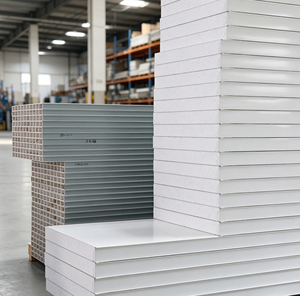
Acoustic & Thermal Barrier

In German building envelope design, high-performance galvanized gutter networks operate in conjunction with insulated sandwich panels, composite decking, and corrugated sheets. Explore our primary manufacturing range exportable direct to German ports.
In contemporary German architectural, commercial, and industrial roofing, selecting roof drainage systems requires navigating rigorous structural standards, localized environmental criteria, and stringent hydrological planning parameters. While titanium-zinc (Titanzink) has historically held strong brand awareness in German plumbing craft (*Spenglerhandwerk*), precision continuously roll-formed hot-dip galvanized steel (Fe/Zn) roof gutters have emerged as the premier structural alternative for large-scale industrial warehouses (*Logistikhallen*), agricultural complexes, and modern modular commercial buildings across Baden-Württemberg, North Rhine-Westphalia, and Bavaria.
The technical preference for galvanized roof gutters (*Dachrinnen aus verzinktem Stahlblech*) across German tenders stems from mechanical superiorities: hot-dip galvanized steel delivers a tensile yield strength ($R_e$) ranging between 280 MPa and 350 MPa (conforming to EN 10346 grades S280GD and S350GD), dramatically outperforming traditional non-ferrous soft metals in structural rigidity. Under substantial snow loads (*Schneelastzonen 1 bis 3 nach DIN EN 1991-1-3/NA*), temperature-induced thermal expansion coefficients for steel ($\alpha \approx 12 \times 10^{-6}/\text{K}$) are half that of zinc or aluminum ($\approx 22\text{--}24 \times 10^{-6}/\text{K}$). This drastically minimizes thermal buckling, reduces required expansion joints (*Dehnungsausgleicher*), and preserves watertightness across continuous continuous runs up to 30 meters.
As a seasoned manufacturer and direct exporter since 2009, Paneltech International LLC delivers fully certified galvanized drainage profiles, high-load gutter brackets (*Rinnenhalter nach DIN EN 1462*), downpipes (*Fallrohre*), and specialized eaves transition flashings that integrate seamlessly with high-efficiency sandwich panels, profiled sheet roofs, and composite floor decks.
Direct comparative parameters between half-round (Form A) and box gutters (Form B) engineered to DIN EN 612 and DIN EN 10346 standards.
| Profile Type | DIN EN 612 Size | Developed Width (Zuschnitt) | Nominal Thickness | Standard Zinc Mass | Typical Downpipe Interface | Primary German Application |
|---|---|---|---|---|---|---|
| Half-Round (Form A) | Size 280 (7-tlg.) | 280 mm | 0.60 – 0.75 mm | Z275 / Z350 (g/m²) | DN 80 (80 mm) | Residential roofs < 60 m², garage bays, ancillary facades |
| Half-Round (Form A) | Size 333 (6-tlg.) | 333 mm | 0.70 – 0.85 mm | Z275 / ZM310 | DN 100 (100 mm) | Standard German multi-family residential, pitched commercial roofs |
| Half-Round (Form A) | Size 400 (5-tlg.) | 400 mm | 0.80 – 1.00 mm | Z350 / ZM310 | DN 120 / DN 150 | Large agricultural halls, public assembly buildings, multi-bay facilities |
| Box Gutter (Form B) | Kastenrinne 333 | 333 mm | 0.75 – 0.90 mm | Z275 / Z350 | Square / DN 100 | Contemporary cubic urban villas, flat eaves fascia designs |
| Industrial Box | Kastenrinne 500+ | 500 – 1000 mm | 1.00 – 1.50 mm | Z350 / Z450 / Coil-Coated | DN 150 / DN 200 | Logistics centers (*Logistikhallen*), siphonic drainage interfaces |
Custom-tailored metallurgical treatments and profile geometry calculated to survive localized physical stresses across Germany's diverse geography.
German logistics hubs throughout the Ruhr Valley and Frankfurt Airport periphery require high-capacity, heavy-gauge box gutters capable of handling siphonic discharge (*Unterdruck-Entwässerung*). Integrated with continuous PIR insulated roofing sandwich panels, our heavy-gauge hot-dip galvanized gutters withstand torrential downpours while preventing interior envelope condensation.
Projects across Southern Bavaria and the Black Forest confront Snow Load Zones 2 and 3 (*DIN EN 1991-1-3*). Standard gutters deform under sliding wet snow packs. We supply S320GD high-tensile galvanized eaves troughs paired with reinforced 30x5mm hot-dip galvanized flat-bar brackets (*Überlastbare Rinnenhalter*), eliminating mechanical deflection during melt freeze cycles.
Agricultural storage sheds and biogas plants throughout Lower Saxony operate in atmospheres heavily saturated with ammonia, biological dust, and chemical mist. Our multi-layer polyurethanecoated galvanized gutters and Magnelis-equivalent Zinc-Magnesium alloy gutters provide advanced chemical self-healing protection that prevents pitting corrosion along standing water lines.
The rapid expansion of prefabricated modular timber and steel buildings across Berlin and Munich demands millimeter-precise, cut-to-length factory flashings and drainage runs. We produce complete plug-and-seal galvanized systems that arrive on site numbered according to erection schedules, saving extensive plumbing labor costs.
Aligning engineering parameters with KOSTRA-DWD rainfall data, GEG building energy legislation, and sustainable building criteria (DGNB / BNB).
German municipal building authorities increasingly enforce DIN 1986-100 and KOSTRA-DWD recalculations, requiring roof drainage systems to withstand 5-minute statistical century rainfall events ($r_{5,100}$). This has caused a decisive shift away from narrow standard gutters toward wide, deep-trough galvanized box profiles outfitted with dedicated emergency overflow channels (*Notentwässerung*), protecting multi-million euro warehouse inventories from internal inundation.
Under the German Sustainable Building Council (DGNB) and Federal Quality Seal for Sustainable Housing (QNG), developers face rigid cradle-to-cradle lifecycle assessments. Steel boasts an uncompromised closed-loop recycling infrastructure across Germany. Hot-dip galvanized steel delivers a significantly lower upfront carbon footprint per kilo than heavy extruded metals, granting projects crucial credits in building sustainability certifications.
General contractors (*Generalunternehmer*) are abandoning fragmented supply chains. Procuring gutters, insulated roof panels, flashings, and structural decking from divergent vendors creates thermal gap mismatches and inconsistent galvanized coating batches. Paneltech International provides an engineered single-source delivery package, guaranteeing color matching, expansion consistency, and coordinated site logistics.
Combining over 15 years of factory-direct metal envelope manufacturing with advanced quality control systems certified for global trade.
Operating our continuous production facility since 2009, we control raw coil slit lines, automated cold roll-forming machines, and 10-meter CNC folding benches for zero-tolerance gutter runs.
Every batch undergoes automated eddy-current coating thickness measurements, cross-cut adhesion tests, and neutral salt spray testing per DIN EN ISO 9227 to confirm barrier longevity.
Eliminate procurement coordination headaches: order your drainage accessories alongside PIR/PU sandwich panels, metal deckings, cold-formed Z & C purlins, and matching trim packages.
Experienced shipping specialists handle full container loads (FCL) to Hamburg and Bremerhaven, offering full Incoterms transparency (CIF, CFR, DDP) and zero-defect seaworthy anti-moisture packaging.
Clear, technically transparent answers regarding European standards, zinc longevity, transport safeguards, and custom sheet folding.